News

Six Months On... Ryan Gregson Blog

posted by rtsam on May 22, 2012, 1:20am


CHECK OUT RYANS OFFICIAL WEBSITE HERE

ryan gregsonIt's been a better period in my running than when I last wrote. Last time I was at the end of an 18 month period of lower leg issues. Now I'm healthy and am running well.


I was able to start running in mid November last year and I had a gradual build up until I went to Falls Creek for a training camp at the end of December. I stayed at Falls Creek for a full month and was in good shape by the end of it. At the start I was getting beaten by the young kids, but by mid January I was showing glimpses of my ability. I was back home in Wollongong in late January and went straight to Adelaide for a 1500m race. It was windy and had no pacemakers so nobody went for it. I ended up winning in 3:47 in a good kick down with Jeff Riseley over the last 200m.


Watch this Photo Clip of the Race...


The next week I headed down to Hobart for an 800m and to pace 3000m of the 5000m race. I was in a good spot in the 800m with 350m to go but was clipped from behind and had a big stumble. I did well to not go down, but I lost 15 metres and then made it all up by the top of the straight. I then faded in the finish because I'd spent my pennies but it was a good sign that I was still able to run 1:49. I then jogged around and kept warm and an hour later I went to 3000m in 8 minutes. Collis Birmingham was really strong after I dropped out, winning in 13:15. I was really happy with the double. To run 8 minutes for 3000m after an 800m was something that I didn't think I'd be capable of at that time with limited training. It's certainly no Mo Farah 1500m/5000m daily double of 3:34 and 13:12, but it meant I was getting strong.


Watch the 5000m at the Briggs Track Classic...


Over the next few days my calf was really tight and on an easy jog one night, I went up a slight rise and tore my calf. It turned out that during the stumble I strained my calf and the running over the next few days turned it into a tear. I called up my coach Nic Bideau and told him the news. 15 minutes later I was sent an itinerary for a flight leaving at 6am the next morning to go down to Ballarat and be treated by David Campbell. Nic doesn't muck around.


David is still studying to be a physiotherapist but he knows more than any of the other physio's I've come across in Australia. He just gets it. He worked hard on me for the next week and turned a 4-6 week injury into only having 8 days off. He is a genius. David has a unique technique that only a few physio's in the World employ, but it's imperative to getting back as fast as possible.


I made it back for the Australian Olympic Trials in Melbourne but I wasn't sure how I'd go. The field was strong with the Olympic and World Champion Asbel Kiprop of Kenya, the Olympic silver medallist Nick Willis, American Dave Torrence who won the Sydney meet in 3:35, and the Aussie thoroughbred Jeff Riseley. Kiprop was talking up plans of running 3:32. I didn't think I'd be able to keep up if it was that fast, but when I woke up on race day and it was blowing a gale, I got excited and thought the race would be brought back to my level. My plan was to hold on for the first 400m, then 800m, then 1200m, and then if I was still there I knew I'd be hard to beat. I ended up running well down the home straight to get a good win in 3:38. It was the biggest win of my short career and was a lot of fun. My Dad and best mate Matt Fox were down there at the finish line and it was good fun in drug testing post race as we were all pretty excited that I pulled off an upset.


Watch the Olympic Trial...


From there I trained hard for a couple of weeks before flying out to the US at the end of March for my 2012 campaign. I started off with the Carlsbad 5000m road race where I ran 13:39. My previous fastest time over 5000m was 13:56 on the track, but my time in Carlsbad didn't surprise me as I predicted that 13:39 was what I'd run if I had a really good day. It'd been over 3 years since I'd ran a 5000m so I was due.


A Short Clip of the Carlsbad 5000 put together by Chris Harmon...


I then headed to Mt. Laguna with Brett Robinson and the Melbourne Track Club crew. Mt. Laguna is the best place in the World to train if you want to get fit fast. We train at 1800m which is optimum height and all the running is hilly which gets you strong. I put a solid month of training in my legs without any stand out sessions. I prefer to tick the training off consistently rather than training like a rock star one day and then being tired the next. Consistency is what I've lacked in my career so far and is what I'm working hard on.


I went to the Penn Relays and after a strong first leg from Jordy Williamsz we struggled to keep up in the DMR. By the time I got the baton we were out of it. I ran decent over the 1600m, clocking 3.55 which is good for me because I'm usually rubbish when I'm on my own.


Coverage of the Mens DMR at Penn Relays...


At this stage I was really excited to get to London. I love London and it feels like home. I've started to develop a good group of friends in the area and we have a lot of fun.


I had a week of training and then headed to Doha for the Diamond League 1500m. This was going to be my best opportunity to get an Olympic 'A' standard. Everything went to plan and I ran 3:33 and booked my ticket to the Olympics. I was well back in the field but hopefully as I get sharper in June and July I can be closer to the front.


This was a pretty general wrap up of where I've been over the past 6 months. Running is starting to become fun again and hopefully I can stay in one piece.


Ryan

The Road Back: A Column By Len Johnson

posted by rtross on May 18, 2012, 2:47pm


Craig Mottram left Australia this week for altitude training in the US and the next step on the road to London.

It sometimes seems we’ve been talking about Mottram’s ‘next step’ for ages, and never the destination. ‘When’s he going to get there,’ we ask ourselves.

The answer, hopefully, is that he’ll get there in London, when he runs the final of the Olympic 5000 metres.


Mottram seemed to come on in leaps and bounds until he reached his performance peak (to date) with his bronze medal in the Helsinki 2005 world championships, his magnificent duel with Gus Choge on the MCG in the Commonwealth Games 5000 and his defeat of Kenenisa Bekele to win a second consecutive World Cup 3000 metres later the same year.

If he did it then, why can’t he do it now, we wonder. Sympathetically, I add, because I am continually surprised by the affection in which Mottram is held in the wider sport of athletics and by the general public. Informed and uninformed fans alike seem to have an appreciation of the magnitude of his achievements against the power of east African distance running.


The answer is two-fold. First, he really didn’t do it overnight then and, second, that’s why it can’t happen overnight now. Mottram’s rise was the result of a long, patient build-up over almost six years and his recovery from career-threatening injury has been a similar building process.

Mottram’s runs in the 5000 at the Australian Olympic Trials and his 3000 metres heat win at the world indoor championships are the most positive signs yet that he can regain that form of 2005-06.

The reasons for Mottram’s gradual recovery from the lower-leg problems which struck in 2008 are complex.


Firstly, the troubles affected everything in the achilles area except the tendon itself. In the manner of such things, too, the problem in one leg eventually affected the other, ‘good leg’ as continued running and racing led to over-compensation.

Achilles are beggars of things to heal. For some lucky ones simple surgical intervention does the trick. Others face a prolonged battle with multiple, and sometimes conflicting, diagnoses and treatment. Mottram had most of the diagnoses, experienced most of the treatments, but the condition stubbornly remained, or recurred after brief improvements.

The achilles and its partners in pain – the bursae, sheaths, paratenons and other attachments – develop their own way of letting you know they are hurting. Sometimes they grumble, other times they moan, occasionally they shriek, always they are curmudgeonly.


Through this, Mottram had a change of coach, too, from Nic Bideau to Chris Wardlaw. It was not a dramatic change in training, but a further complication.

Next, look at the timetable of Mottram’s rise, and return.

It took ‘old Mottram’ a long time to attain his high point. From his first Olympic team in 2000 (run out in the 5000 heats), Mottram was a semi-finalist in the 1500 at the 2001 world championships, a distant sixth behind three Kenyans and two Englishmen (fifth, Sam Haughian, who he?) at the Manchester Commonwealth Games, and a spectator at the 2003 world championships with a leg injury.

It was not until 2004 that Mottram ran his Australian record 12:55.76 just behind Gebrselassie in London (“who was that long guy”, the legendary Ethiopian asked famously) and finished eighth in the Olympic final, and 2005 in Helsinki that he took a bronze medal at the world championships.


So it took five years to build the old Mottram. It may take just as long to get back to that level.

Undoubted it is that each year has brought progress. Mottram returned with a 13:50 5000 at Geelong’s Landy Field in late 2009, followed by a 13:22 for the opening 5km leg in the Chiba Ekiden Relay.
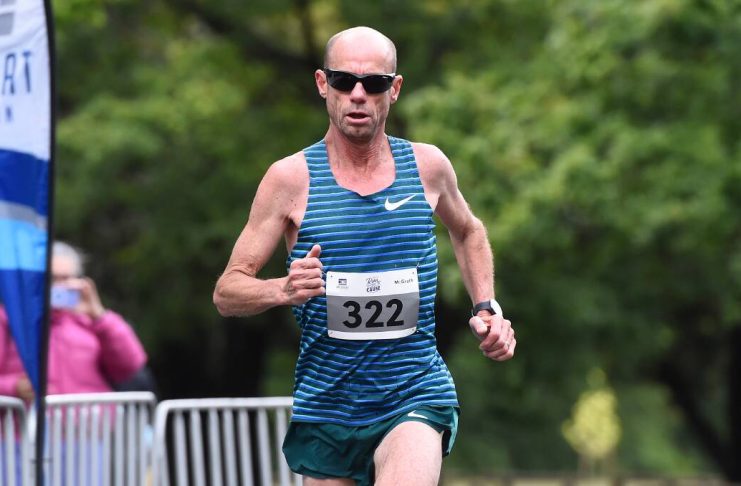
In 2010 Mottram ran 7:45 and 13:36 in Europe, but his return to Chiba yielded ‘only’ a 13:49 for the same leg he had run almost 30 seconds faster the previous year.

In 2011, there were more highs – a 13:25 5000 in Melbourne, 21st in the world cross-country, 13:11 in Europe among them – than lows, but one of the lows was a disappointing heat run at the world championships in Daegu.

Olympic year has begun very promisingly indeed – a win over the in-form Collis Birmingham in the 5000 at the Melbourne Track Classic and Olympic Trials; a strong performance at the world indoors; a solid run in the Victorian cross-country relays and more good training. Some of the old confidence appears to have returned with these more consistent performances.

If he can carry that confidence into the next few weeks and translate it into strong races at the Eugene and New York Diamond League meetings, perhaps we will see a fit, confident Craig Mottram taking on the world in London.

Now that would be great for Craig Mottram, and great for the sport.

Jeff Hunt & Martin Dent added to Olympic Team

posted by rtsam on May 16, 2012, 5:17am


jeff huntmartin dentRunner’s Tribe is pleased to announce that Athletics Australia (AA) have selected both Jeff Hunt and Martin Dent to represent Australia at the London Olympics marathon. Hunt and Dent will join Michael Shelley who will combine together forming a strong treble to represent the green and gold.


The selection marks a reversal in the selection policy from AA, who had previously held the line that Australian marathoners must break the 2:12 mark in order to qualify.  
 

Runner’s Tribe would like to congratulate both Jeff and Marty on their selections, and wish them all the best for their preparation leading into the Games.

Athletics Australia announce dates for 2013 Nationals

posted by rtross on May 15, 2012, 1:02am


Athletics Australia can today confirm the location and dates of the 91st Australian Athletics Championships and the Australian Junior Athletics Championships to be held as part of the National Athletics Series in 2013.


The 91st Australian Athletics Championships will be held across four days from Thursday, April 11 to Sunday, April 14 2013.


It sees the Nationals return to Sydney (NSW) for the first time since 2006 after Athletics Australia selected a bid by Destination New South Wales and the Sydney Olympic Park Authority to host a number of athletics events in the coming years, including continued support for the Sydney Track Classic.


The Australian Athletics Championships will double as the Selection Trials for the 14th IAAF world championships in Moscow (RUS) in August 2013 and incorporate the Australian Combined Events Championships.


The Australian Junior Athletics Championships will for the first time head west, with Perth (WA) welcoming more than 1700 expected entrants across six days from Tuesday, March 12to Sunday, March 17 2013.


Perth will host the Australian Junior Athletics Championships as part of a four-year deal agreed to with the Western Australian Government that commenced with the 2012 Go for 2&5 Perth Track Classic earlier this year.
 

The deal, set in conjunction with Athletics Western Australia, ensures an unprecedented level of support for the grassroots of the sport, with the Western Australian government the first state ever to offer substantial financial support for the Australian Junior Athletics Championships and its supporting pathway.


Additionally, events for Under 18 aged athletes will be the Selection Trial for the 8th IAAF world youth championships, which will be in Donestk (UKR) in July 2013.


Andrew Matthews, Athletics Australia Competitions Manager, said: “This is a great result for the sport, with our two most important events being hosted in two of Australia’s best cities with the support of the relevant state governments.


“This support ensures that we can deliver the best possible event for athletes, coaches, officials and spectators alike, with a key focus on working to develop both events as the pinnacle meeting on both junior and senior athletics calendars.


“Importantly at an open age level, the timing of the event also provides a great opportunity for athletes to qualify for the IAAF world championships and through consultation with our High Performance Department this has been considered in nominating the above dates.


“An 18-month plan is also underway, with dates for 2014 also expected in the coming month, so stay tuned for an update. This will ensure a long-term vision that provides ample opportunity for athlete planning.”


Athletics Australia will announce dates for other meets to be hosted as part of the 2013 National Athletics Series, including the 2013 Australian Athletics Tour, in the coming weeks.


AUSTRALIAN JUNIOR ATHLETICS CHAMPIONSHIPS

Perth, Western Australia

Tuesday, March 12 – Sunday, March 17, 2013


91st AUSTRALIAN ATHLETICS CHAMPIONSHIPS AND SELECTION TRIALS

Sydney, New South Wales

Thursday, April 11 – Sunday, April 14 2013

Tallent wins bronze at IAAF World Race Walking Cup

posted by rtross on May 13, 2012, 3:16pm


Australian Flame Jared Tallent (Vic) has this evening clocked a season best 3:40:32 to win the bronze medal in the men’s 50km walk at the IAAF World Race Walking Cup.


Heading out quickly alongside Jianguo Zhao (CHN), Tallent and his Chinese rival moved through five kilometres together in 22:10, with a Russian pack of five eight seconds off the pace.


Holding their lead through 10 kilometres (43:58) and 15 kilometres (1:05:45), Zhao then dropped off, with Tallent joined in the lead pack of six by a Russian quintet of Sergey Bakulin (1:27:33), Igor Erohkin (1:27:34), Sergey Kirdyapkin (1:27:34), Ivan Noskov (1:27:35) and Mikhail Rhyzov (1:27:35).


Bakulin, Tallent and Erohkin then broke away again at the half-way point to sit 20 seconds clear, before Kirdyapkin joined the lead pack at 30 kilometres to see the clock tick over 2:11:00.


At 40 kilometres (2:55:10), it was Bakulin who fell off the pace, with the trio of Kirdyapkin, Erohkin and Tallent holding the top-three places to cross in the gold (3:38:08, world lead), silver (3:38:10) and bronze (3:40:32) medal positions respectively.


Tallent said: “I’m really happy with a bronze medal, especially in a race that was as strong as today, but I would have loved the gold here at the home of walking in Russia before heading to London.


“The host nation proved why they are one of the best at race walking, and for me I now know what I need to work on to make sure that I am better than I was here at the Games. I am so very keen to move to the top of the podium, and I think with some work on my areas of weakness, for example the final stages, it is something that could become a reality if things go my way.


“I’m looking forward to heading back to Canberra from here for a pretty big month of training, then we will head to St Moritz for our final preparations. The Games are not far away and I’m ready to put the work in for a big result.”


Tallent’s performance today is his third fastest across the distance ever and adds a second individual IAAF World Race Walking Cup medal to his burgeoning trophy cabinet. He has also won a team silver (2006, 20km walk) and team bronze (2008, 20km walk).


It also sends an ominous warning that the Olympic nominee will, pending official selection, head to London in blistering form and in contention to back up the silver (50km walk) and bronze (20km walk) medals he won at the 2008 BeijingOlympics and the bronze medal (50km walk) he won at last year’s IAAF world championships.


Tallent is a three-time 50km walk national champion and a five-time national 20km walk champion. He has donned the green and gold of Australia at five IAAF World Race Walking Cups, four IAAF world championships, two Commonwealth Games and theBeijing Olympics.


Tallent was joined on the start line today by Regan Lamble (Vic), Claire Tallent (SA), Beki Lee (NSW) andNicole Fagan (NSW), who combined to form the Australian team in the women’s 20km walk.


Lamble was the best placed in 25th (1:34:34, season best), while Lee finished 58th (1:41:23). Tallent was disqualified and Fagan did not finish.


For full results from the IAAF World Race Walking Cup, please click here.


To read about day one action at the IAAF World Race Walking Cup, please click here

Kenny, can he? A Column By Len Johnson

posted by rtross on May 12, 2012, 2:31pm


For pretty much all this century, Kenenisa Bekele has been the monarch of all he surveys. Four times world championships gold medallist at 10,000 metres and twice Olympic champion.

Twice at the world championships and once at the Olympics, King Kenny added the 5000 metres to his gold medal haul. Twice he set world records at 10,000; once at 5000: he still holds both.


At cross-country, Bekele has been even more dominant. Five times in succession he won the short race/long race double, adding a sixth long-race title in 2008 after the short race had been dropped. His era of dominance started over the country, too, with his win in the 2001 junior race.

Now, amazingly, King Kenny’s royal coffers are nearly empty. Should he make it to the Olympics in London later this year, he will be lining up to defend one or both of the only titles he still holds, the Olympic 5000 and 10,000 metres.

Kenny, can he?

Less than three years ago in Berlin, the question would have reeked of ignorance, at best, impertinence, at worst. Watching Bekele completely control the last four laps of the 5000 metres, increasing the pace step-by-step to thwart rivals led by Bernard Lagat, his powers were at their peak.

The Berlin 5000 completed a double (he had already won the 10,000) - a double-double, moreover, as he had also won both events in at the Beijing Olympics the year before. In the minds of most – if not their hearts – he had surpassed even his exalted predecessor as Ethiopia’s greatest gift to world distance running, Haile Gebrselassie.

Bekele had also responded to the first challenge to his hegemony. That had come in the world cross-country two years earlier, in hot and steamy Mombasa on Kenya’s coast, when he had lost to Zersenay Tadese of Eritrea.


Not just lost, either; Bekele had stepped off the course when the Eritrean applied the pressure late in the race. He said he was feeling the heat – fair enough, everyone was, but it looked as much as if he had calculated he could not win in Mombasa’s heat rather than the heat had directly done him in.

Bekele started to dispel any notions of vulnerability when he won the 10,000 for the third time later that year at the world championships in Osaka. Whatever happened in Mombasa, he was grit personified in Osaka’s sweltering conditions, chasing down teammate Sileshi Sihine when the latter looked to have forged a winning break in the final lap.

The next challenge, though, was injury. Not long after his Olympic double triumph, Bekele made a rare road appearance, finishing third in the Zevenheuvelenloop (Seven Hills Run) 15km in the Netherlands. He pulled up sore in the calf and, in January 2009, tore the muscle in a cross-country race in Edinburgh. The injury recurred after his Berlin double.

Subsequent recovery was slow. A hard track at the Ethiopian training centre in Addis Ababa was blamed for the injury. Bekele is building his own track – a softer one - at another facility.

At last, Bekele re-emerged at the world championships in Daegu. Without any lead-up track racing, he used his champion’s wild card. To no avail, however, as he gave up his career unbeaten record at 10,000 when he stepped off the track after 7000 metres.

Nineteen days later came an amazing turnaround: Bekele won the 10,000 at Brussel’s Van Damme Memorial in a world-leading 26:43.16. It is hard to imagine two more contradictory performances.

Was Brussels then the real Bekele? Maybe; maybe not: Olympic year began with a comprehensive loss in the 4km at the Edinburgh cross-country.


Evidently out-of-shape, Bekele went back to some serious training. Now, reportedly 4-5kg lighter and in reasonable form – he won a hilly road 10km in Dublin in 27:50-ish – Bekele is ready to test himself on the track.

Overnight, Bekele was running the 3000 at the opening IAAF Diamond League meeting in Doha. He is down to run the 5000 at the Shanghai DL the following weekend and again at the Prefontaine Classic DL in Eugene on 2 June where his opponents will include world champion Mo Farah.

If he gets to London, Kenenisa Bekele will be attempting a feat which defied the great Emil Zatopek, Lasse Viren and, more recently and relevantly, Gebrselassie. All won consecutive Olympic 10,000 titles, none was able to make it three in a row.

Once we see how Bekele comes through his next few races, we will have a far better idea whether King Kenny can add one more bit of history to his stunning career resume.

Hooker and Gregson stake claim for London

posted by rtross on May 11, 2012, 2:58pm


A third Olympic Games are closer to a reality for reigning champion Steve Hooker (WA) after the 29-year-old sailed over 5.72m in Perth (WA) tonight, while Ryan Gregson (NSW) recorded his first Athletics Australia qualifier for London 2012 across 1500m at theSamsung Diamond League in Doha (QAT).


Hooker opened his campaign at his indoor training facility with a second round clearance of 5.52m before making light work of 5.62m on his first attempt. Recovering after a narrow miss on his first tilt at the Olympic qualifying mark, the Australian and Oceania record holder soared over 5.72m with ease when next given the chance.


Hooker said: “I’m very, very relieved but at the same time so damn excited.


“For a while there I thought I was a shoe in to make London and losing that certainty and having to fight like I have to get back was a challenge I didn’t see coming. It is something that I am just stoked to have gotten over.


“It has been months and months of jumps, jumps and more jumps – thousands of jumps, seriously – to be back at this level. We stripped it right back to basics, made a real effort to get the things that were letting me down right and from there begun the process of building my heights up.”


Set to join his international rivals at Round 2 of the Samsung Diamond League in Shanghai (CHN) next weekend, Hooker is acutely aware that tonight’s result, while fantastic, is simply a milestone in a much bigger plan.


Hooker said: “This is great, but it is only one thing on the road to London.


“I now need to get into the rhythm of competing again, and doing that in conditions where not all the variables are controlled. That’s why I’m looking forward to Shanghai and then Europe as it will be where I can continue to develop before the Games in situations that are out of my power and againstathletes that will challenge me the whole way to London.”


Hooker was joined on the runway by former national champion Blake Lucas and IAAF world youth championships finalist Brodie Cross, with the Victorian duo clearing 5.02m and 4.82m respectively. In the women’s event, world junior championships bound Liz Parnov (WA) cleared 4.22m off eight steps, while Australian record holder Alana Boyd (WA) set a new six-step approach personal best of 4.12m.


The reigning Olympic champion, Hooker’s international resume also includes the 2009 world title, the 2006 and 2010 Commonwealth Games gold medals, the 2010 world indoor championship and a 6.06m Australian and Oceania record.


He is a three-time national champion and the current captain of the AustralianFlame, Australia’s athletics team.


Meanwhile, at Round 1 of the Samsung Diamond League in Doha (QAT), Gregson clocked a season best 3:33.92, his second fastest time ever and his first Olympic qualifier, for 11th in a stacked men’s 1500m.


Gregson sat within the lead pack through 800m in 1:52.06, before Silas Kiplagat (KEN), the race winner, andAsbel Kiprop (KEN) picked up the pace to cross in a world lead time of 3:29.63 (first) and a personal best time of 3:29.78 (second) respectively. The race was the fastest since 2010, with thirteen athletes crossing below the Olympic standard of 3:35.50.


Gregson’s time suggests the 21-year-old is returning to the form that saw him improve the national record ofSimon Doyle (Qld) to 3:31.06 at the Monaco Diamond League in 2010. Most importantly, though, it brings him into contention for nomination to the Australian Olympic Committee for selection to the 2012 Olympic Games.


The 2010 national champion, Gregson in 2012 has placed third (1:49.82) across 800m at the Briggs Athletics Classic, and taken victory twice across 1500m at the Adelaide Track Classic (3:47.84) and the Qantas Melbourne Track Classic andOlympic Trials (3:38.51).


An IAAF world youth and IAAF world junior championships representative, Gregson made his open age debut with the inaugural Australian Flame team at the 2009 IAAF world championships in Berlin (GER). He was forced to miss the 2010 Commonwealth Games with injury, before making a semi-final (3:47.89) at the2011 IAAF world championships in Daegu (KOR). If he is nominated and selected for London, it will be his first Olympic Games.


In other Australian results:

-       Commonwealth champion Benn Harradine (Vic) backed up his new national record mark of 67.53m from Townsville (Qld) last weekend with a 64.29m hurl for fifth in the men’s discus throw. Opening his campaign with a foul, Harradine wrapped up his four throw series with 60.22m, his best mark in round three and another foul. The event was won by Olympic and world championships silver medallist Poitr Malachowski (POL), who threw 67.53m, with Ehsan Hadadi (IRI, 66.23m) second and Zoltan Kovago(HUN, 65.77m) third.

-       Kim Mickle (WA) hit a best mark of 60.87m for sixth in the women’s javelin throw. Mickle’s best throw came in round one with her series also including a foul, 59.39m and 57.44m. The event was won by world champion Mariya Abakumova (RUS) after she stole the lead from world record holder Barbora Spotakova (CZE, second, 66.17m) with a 66.86m throw.

-       IAAF world championships semi-finalist Lauren Boden (ACT) clocked 55.75 for fourth in the women’s 400m hurdles behind a dominant Olympic champion Melaine Walker (JAM) who set a world lead 54.62 to take victory. For Boden, the time is her fastest internationally this year and her fastest ever at a Diamond League event.

-       Eighteen-time national champion Tamsyn Manou (Vic) clocked 2:02.75 for 11th in the women’s 800m as Olympic champion Pamela Jelimo (KEN) set a world lead and meet record of 1:56.94 to secure the first four points in the Diamond Race.

-       National champion Vicky Parnov (WA) sailed over 4.00m on her second attempt, before missing at 4.20m to finish 11th overall.


In other Diamond League highlights:

-       World championships silver medallist Walter Dix (USA) secured the first points of the men’s 200m Diamond Race with a 20.02 (w: -0.5) meet record for the win from Churandy Martina (NED, second, 20.26) and Jasumy Saidy Ndure (NOR, third, 20.34).

-       The women’s shot put was won commandingly by Nadezhda Ostapchuk (BLR) with a meet record throw of 20.53m from Jillian Camarena-Williams (USA, second, 19.81m) and Nadie Klienert (GER, third, 19.67m), who bost threw a season best.

-       David Rudisha (KEN), who won the 800m at the Qantas Melbourne Track Classic in 1:44.33, clocked a world lead 1:43.11 to win the men’s 800m.

-       American duo Justin Gatlin (9.87, w: +0.4) and Allyson Felix (10.92, w: +0.7) won the men’s and women’s 100m respectively.

-       LaShawn Merritt clocked a world lead of 44.19 to take home the victory in the men’s 400m, withLuguelin Santos (DOM, 44.88) second and Angelo Taylor (USA, 44.97) third.

-       Aleksandr Menkov (RUS) takes an early lead in the men’s long jump Diamond Race after winning the event with 8.22m (w: +1.4). Godfrey Mokoena (RSA, 8.10m, w: +0.9) was the next best and Ndiss Kaba Badji (SEN, 8.04m, w: +0.9) behind him in third.


To view and download full results from the Samsung Diamond League, please click here.


Eurosport will replay the Doha insalment of the Samsung Diamond League at 6:00pm AEST on Saturday, May 12 and 3:30pm AEST on Monday, May 14


The Samsung Diamond League now moves to Shanghai (CHN) on Saturday, May 19.


May 19: Samsung Diamond League (Round 2) – Shanghai (CHN)

800m: Jeff Riseley (Vic)

1500m: Kaila McKnight (Vic)

Triple jump: Henry Frayne (Qld)

Pole vault: Steve Hooker (WA)

Discus throw: Dani Samuels (NSW)


- ENDS -


2012 IAAF  WORLD JUNIOR CHAMPIONSHIPS

July 10 - July 15, 2012

Barcelona, Spain

For more information, please follow this link to the IAAF website.


2012 OLYMPIC GAMES

July 27 - August 12, 2012

London, Great Britain

For more information, please follow this link to the London 2012 website.


2012 PARALYMPIC GAMES

August 29 - September 9, 2012

London, Great Britain

For more information, please follow this link to the London 2012 website.

Mickle, Gregson, Manou, Boden & Co; all set for Doha

posted by rtsam on May 9, 2012, 9:33pm


Six head to Doha as walkers prepare to battle it out in Saransk


kim mickleWorld class athletics will return in the form of the Samsung Diamond League in Doha (QAT) on Friday night, as Australia’s best walkers get set to battle it out at the IAAF World Race Walking Cup in Saransk (RUS) across the weekend.


Set to make her 2012 international debut, and only her second competitive appearance this year is Kim Mickle (WA) following a long spell of rehabilitation that followed last year’s IAAF world championships where she competed with broken ribs to finish sixth.


The 27-year-old believes the injury may now be a blessing in disguise because it has allowed her to perfect her run up – the key to a long throw.


A testament to that was the 61.70m she heaved to win her seventh national title at the Australian Athletics Championships last month in Melbourne (Vic).


Mickle said: “I don’t actually think any of the girls know that I broke my ribs in that final apart from maybe Sunette Viljoen (RSA) because we’re friends and we Facebook a lot.


“I’m expecting most of the top eight girls to be competing in Doha, I know the world record holder Barbora Spotakova (CZE) and world champ Mariya Abakumova (RUS) are, as no-one has really had a hit out yet.


“I’ve never competed in Doha before, I’ve just seen it from the plane as I change over through Dubai but Steve Hooker has been telling me it’s an architectural dream and that the place is unreal.


“The Nationals were the first time I had a crack at my run up. That was a hit and miss competition, so to throw 61.70 when I felt out a bit out of control was just ripper.


“I’m starting to control the run up now and so I’m quietly confident that I will throw well in Doha. I haven’t got a really good throw out yet which means none of the girls will probably be looking out for me.”


Joining Mickle in Doha are fellow Australian Flame athletes Tamsyn Manou (Vic, 800m), Tamsyn ManouLauren Boden (ACT, 400m hurdles), Vicky Parnov (WA, pole vault), Ryan Gregson (NSW, 1500m) and Benn Harradine (Vic, discus).


Manou and Boden will line up after recent competition in Japan, while Parnov’s return to the runway is her first since winning the Australian title with a leap of 4.20m last month. Gregson joins Olympic champion Asbel Kiprop (KEN) on the entry list for the men’s 1500m and Harradine is in blistering form after a new national record of 67.53m last weekend.


Meanwhile, in Saransk, a team of 16 including Australian Flame Luke Adams (NSW), Chris Erickson (Vic), Adam Rutter (NSW), Regan Lamble (Vic), Jared Tallent (Vic) and Claire Tallent (SA) will face off with the world’s best across 10 kilometres (junior), 20 kilometres and 50 kilometres at the IAAF World Race Walking Cup.


Australia has enjoyed a strong history of success at the biennial event since its inception in 1979, highlighted by Simon Baker, a team coach in 2012, winning over 50km in 1989, silver medals to Kerry Saxby-Junna over 10km in 1989 and Baker over 50km in 1991, and bronze medals to Susan Cook over 10km in 1983, Nathan Deakes over 20km in 2004 and J. Tallent across 50km in Chihuahua (MEX) in 2010.


In 2006 Australia claimed its first senior men’s team medal, taking silver in the 20km event (Adams, Erickson, Rutter, J. Tallent), before going on to claim bronze in the same category in 2008 (Adams, Duane Cousins, Deakes, Rutter, Tallent). Australia’s senior female team has placed third on three occasions, taking home the bronze medal in 1981 (5km), 1983 (10km) and 1987 (10km).


J. Tallent said upon selection: “The World Cup will be the final competition for us before the Olympics and we’re expecting it to be extremely tough in Russia.


“Of course the goal is to medal but it will be hard to get on the podium, but if I do it will be a massive boost leading into the Games, knowing that we’ve overcome extreme conditions, travel and tough competition.


“Saransk has a great walking tradition, it’s where the Russian training centre is and they literally have hundreds of athletes training there. They will have so much support and a very strong team.


“I think our women’s team can do reallywell this time. We have a quality team and overall we’re shaping up to match, if not better, our previous top five from two years ago.”


May 11: Samsung Diamond League (Round 1) – Doha (QAT)

400m hurdles: Lauren Boden (ACT)

800m: Tamsyn Manou (Vic)

1500m: Ryan Gregson (NSW)

Pole vault: Vicky Parnov (WA)

Discus throw: Benn Harradine (Vic)

Javelin: Kim Mickle (WA)


Please click here for more information, including entry lists and live results.


Round 1 of the Samsung Diamond League will be televised LIVE and EXCLUSIVE by EUROSPORT from 2:00am AEST on Saturday, May 12


It will be replayed at 6:00pm AEST on Saturday, May 12

and 3:30pm AEST on Monday, May 14


May 12-13: IAAF World Race Walking Cup – Saransk (RUS)

10km walk (junior): Nathan Brill (Vic), Jesse Osborne (Qld), Blake Steele (SA), Kristie Goznik (SA), Rachel Tallent (Vic)

20km walk: Luke Adams (NSW), Dane Bird-Smith (Qld), Rhydian Cowley (Vic), Chris Erickson (Vic), Adam Rutter (NSW), Nicole Fagan (NSW), Regan Lamble (Vic), Beki Lee (NSW), Claire Tallent (SA)

50km walk: Jared Tallent (Vic), Ian Rayson (ACT)


Please click here for more informaton, including entry lists and live results


- ENDS -


2012 IAAF  WORLD JUNIOR CHAMPIONSHIPS

July 10 - July 15, 2012

Barcelona, Spain

For more information, please follow this link to the IAAF website.


2012 OLYMPIC GAMES

July 27 - August 12, 2012

London, Great Britain

For more information, please follow this link to the London 2012 website.


2012 PARALYMPIC GAMES

August 29 - September 9, 2012

London, Great Britain

For more information, please follow this link to the London 2012 website.


ENDS


A hip, hip hoo--- kind of week: By Len Johnson

posted by rtross on May 4, 2012, 7:01pm


It’s been a hip, hip, hoo--- kind of week, with several breakthrough performances by rising Australian distance runners and, finally, some relay good news with the Australian men’s 4x100 metres relay putting itself well among the top 16 teams who will qualify to run the London 2012 Olympic Games.

I’d like to be able to say a hip, hip hooray! kind of week, but the good news was balanced by some bad, including the relay bad news that the men’s 4x400 squad, our most successful relay event at recent major championships, produced two mediocre performances and now faces an uphill battle to participate in London, and that none of the distance performances actually qualified anyone for the Olympics.

Let’s be glass half-full people and start with the good news. Now I notice that some US columnist wants to make the distance medley relay – known to cognoscenti as the DMR, which is not to be confused with the zone separating the two Koreas. That’s the DMZ: people fight over it, something like they do the inside running in the DMR, so perhaps there’s the link – anyway, he wants to make the DMR an Olympic event.


Until it is, I say don’t worry about it too much. It’s fun, full of sound and fury, but signifying nothing much. But the DMR at the Penn Relays did at least serve to indicate that Ryan Gregson is in good shape. He ran 3:55 for the 1600 leg. Hopefully this is the year he stays injury free and shows what he is capable of on the big stage.

The major disappointment at Penn was the 4x400 relay. With an Olympic silver in Athens (and a place in the final in Beijing), a world championships bronze in Berlin and a Commonwealth gold in Delhi, the men’s 4x4 has been the flagship of our relays for the past several major championships.

But the relay ranks 17th on the Olympic qualifying list at the moment and needs  run of 3:04 or better to advance to a position of relative safety inside the top 16. That should not be such a hard task for a squad which ran 3:01.56 in Daegu, where it failed narrowly to make the final.

He squad has several more chances before the 2 July deadline, too, but they won’t come any better than Penn where Australia had the US, Jamaica and the Bahamas to run against. Injury to John Steffensen and illness to Sean Wroe (reportedly a burst appendix) weakened the first-choice line-up and Alex Beck, Ben Offereins, Kevin Moore and Steve Solomon could do no better than 3:05.93.


Qualifying top 16 is based on aggregate of two fastest times in the period and as another squad had run 3:05.84 in Brisbane in January, this represented no improvement.

So at 17 we remain, the only saving grace being that team 18 and 19, Grenada and Nigeria, did not get past us.

A squad of Craig Burns, Alex Carew, Kurt Mulcahy and Brendan Cole did even worse (3:07.97) in Shizuoka, Japan, on 3 May, though again the consolation was the Japan, at number 16, did not improve either.

The other slew of encouraging results came from the Payton Jordan meeting at Stanford on 29 April where Liam Adams, Harry Summers and Lara Tamsett all had big time breakthroughs, David McNeill backed up his Olympic A-qualifier at 5000 with a near personal best at 10,000 and Collis Birmingham produced a solid run.

Adams was not even in the A-race, though he might have been had he hot had such a disappointing domestic season, including a decisive loss to Summers in the three-man Australian 5000 championship race just a fortnight earlier. Overall, his track performances have never quite matched those at cross-country (37th in the 2010 world championships, second in the World University championships) and road.

In Stanford, though, Adams made the leap he has always promised, slashing 37 seconds off his previous best in finishing second in the B-race in 28:11.76, just 0.01 behind the winner.

Summers likewise ran a big ‘pb’ in the A-race, finishing 21st in 28:13.23. that was a massive 26 seconds under his previous best.

Like Adams, Lara Tamsett has not produced results on the track commensurate with her world cross-country (best of 26th in 2009) and road performances. Here, however, she ran 32:01.60 a 19-second improvement on her previous best.

Back to the men’s A-race and McNeill who was 20th in 28:09.58, just over six seconds slower than his ‘pb’, but coming after his 13:19.31 the previous week, a good consolidating run.

Only Birmingham was mildly disappointing. His 28:06.63 was by no means disastrous but also nowhere near the national record being talked up pre-race and even by the commentators on the livestream cover of the meeting.

With Eloise Wellings racing for the second time in 10 days (13:20.28) in the 5000 and Emily Brichacek (15:30.00) and Georgie Clarke (15:31.29) running strongly, there are encouraging signs of more to come.

Maybe we can even add the missing ‘---ray’.

PENN RELAYS COVERAGE

PAYTON JORDAN INVITE STANFORD COVERAGE

Get the Numbers at the Ball: Ken Green Interview

posted by rtross on May 1, 2012, 6:28pm


With final Olympic marathon selections just over a week away, we caught up with the coach of Australian marathon runner Jeff Hunt. With surmounting controversy surrounding Athletics Australia’s hard line policy on selection, and their decision to so-far hold to their own qualifying standards of 2:12, instead of those set by the IAAF of 2:15. We caught up with the coach responsible for the rise of Jeff Hunt to get his thoughts on the situation as it currently stands.

RT: Ken, thanks for your time. Thoughts on Jeff’s 2:14 in Hamburg last weekend?

KG: In a word ‘disappointing’. It was always going to be a big-ask only several weeks after Beppu. The fact Jeff went to Germany at his own expense, and for the greater part of the race gave himself every chance to run 2.12 showed his character. 

RT: What have Athletics Australia told you and Jeff in regards to Olympic qualification?

KG: Well at this point they have held the line on the 2.12. I have had good, open discussion with the High Performance Manager, and with the Head of Selectors. I’ve been allowed to put my point across. Whether it has been enough will be determined at the selectors’ meeting on or about 11 May. I would have liked a face-to-face forum with the CEO, and Board members but this has not been forthcoming. At the end of the day the CEO/Board ratifies policy and the administration are charged with the responsibility to manage and implement.

RT: What is your opinion on the tough stance on selection and not abiding to the IAAF qualifying standards of 2:15?

KG: Upfront let me say I am Jeff’s personal coach so of course I wish him to go to the Olympics. I understand the high performance model or philosophy in lifting standards, etc. But it is a double edged sword. I don’t completely buy into the argument that other countries have done the same, or that 2.15 is a particularly soft standard (in any case Jeff and Martin Dent are proven 2.11 & 2.12 athletes). If other countries wish to make what I believe to be a mistake there is no reason we should do the same. Incidentally England has just selected a marathon runner with a 2.13 PB?

As a sport we need to encourage people like Jeff, and Martin Dent - they do not earn big money! Their reward, in my opinion, for years of commitment, service and participation to AA events both domestically and internationally is the opportunity to represent Australia at the highest levels. It is also for me, in part, a development argument. We need better international performances at the longer distances (including World Cross Country). And yes; lifting selection standards is one option but also there is a prevailing view that we need a five to seven year plan, and to get ‘numbers at the ball’. We would benefit from umpteen emerging distance runners thinking “if the likes of Hunt & Dent can make Olympic teams then so can I”. We will struggle to unearth the next ‘Deek’ or ‘Monna’ unless we get numbers participating.    

I won’t go into a long list of statistics (and I acknowledge there are arguments both ways) but if either Micheal Shelley (PB 2.11:20), and/or Jeff Hunt (PB 2.11:00), and/or Martin Dent (PB 2.12:15)  reproduce their best at the Olympics it is not unreasonable to suggest a top 16, or better, as a likely outcome. Why not have all three there; it gives the team a better chance.

RT: Do you understand Eric Hollingsworth’s logic, or the Selectors position?

KG: It would be disingenuous of me to criticise Eric. For the leading athletes I coach Eric has been supportive. He’s kept Jeremy on the radar through his rough patch of injuries, he funded Jeff to Beppu when he ran his 2.11, has been patient with Bridey, and we are currently talking about how we can accelerate Nipper’s development to become a leading international steeplechaser. Whether the policy or logic is Eric’s or not is a moot point – it’s the sport’s policy and to me that includes the Board/CEO/Selectors and others. Again as Jeff’s personal coach I believe he has done enough to be given an opportunity. The current policy if adopted as written is prohibitive. To be fair to Eric, and the selectors I have had frank open debate on the application of the policy (without fear or favour) and we are where we are. So I remain hopeful that logic (discretion) is exercised by the selectors.

RT: People could argue that Jeff did not perform in Daegu and therefore should not be shown leniency, thoughts on this?

KG: I’d like these people to front up and face me on this point. Jeff was the only male or female Australian marathoner to put his hand up for Daegu. He knocked back a very, very lucrative offer from a City-USA marathon so he could get to Daegu. Several others could have turned up at Daegu and did not. Jeff should be applauded for his brave decision. Yes he struggled in Daegu and damaged his calf. In hindsight this limited his preparation for Beppu February 2012.

 RT: Jeff seems to dislike really humid conditions, but thrives in mild to cool climates. London would seem to be the perfect setting for him to race well?

KG: His record would support this point. I’m hopeful he will get the chance to take opportunity of the conditions that might present in London. I’m equally as hopeful he can be supported and encouraged to go to the World Championships in 2013 in Moscow. We have to work through the climate challenges. It’s not insurmountable.  

RT: So far this year there have been 111 athletes to break the 2:10 mark. Time-wise it is clear that Jeff is a long way from the best, whether he ran a 2:12 this year or a 2:15 it really wouldn’t change anything in this respect.  However, in reality we all know that championship racing has less to do with times posted and more to do with what eventuates on the day. Do you feel Jeff is the sort of athlete who could rise to the occasion given the opportunity?

KG: Of course I think he can rise to the opportunity. Fortunately for every country in the World only 3 Kenyans and 3 Ethiopians will be on the start line in London. I am prepared to bet now 1st to 6th will not be solely from Kenya or Ethiopian, or be the top 6 ranked marathoners.   

Post your comments on this article on our Face Book Page

http://www.facebook.com/runnerstribe?ref=tn_tnmn


Go to page:
Recent Posts